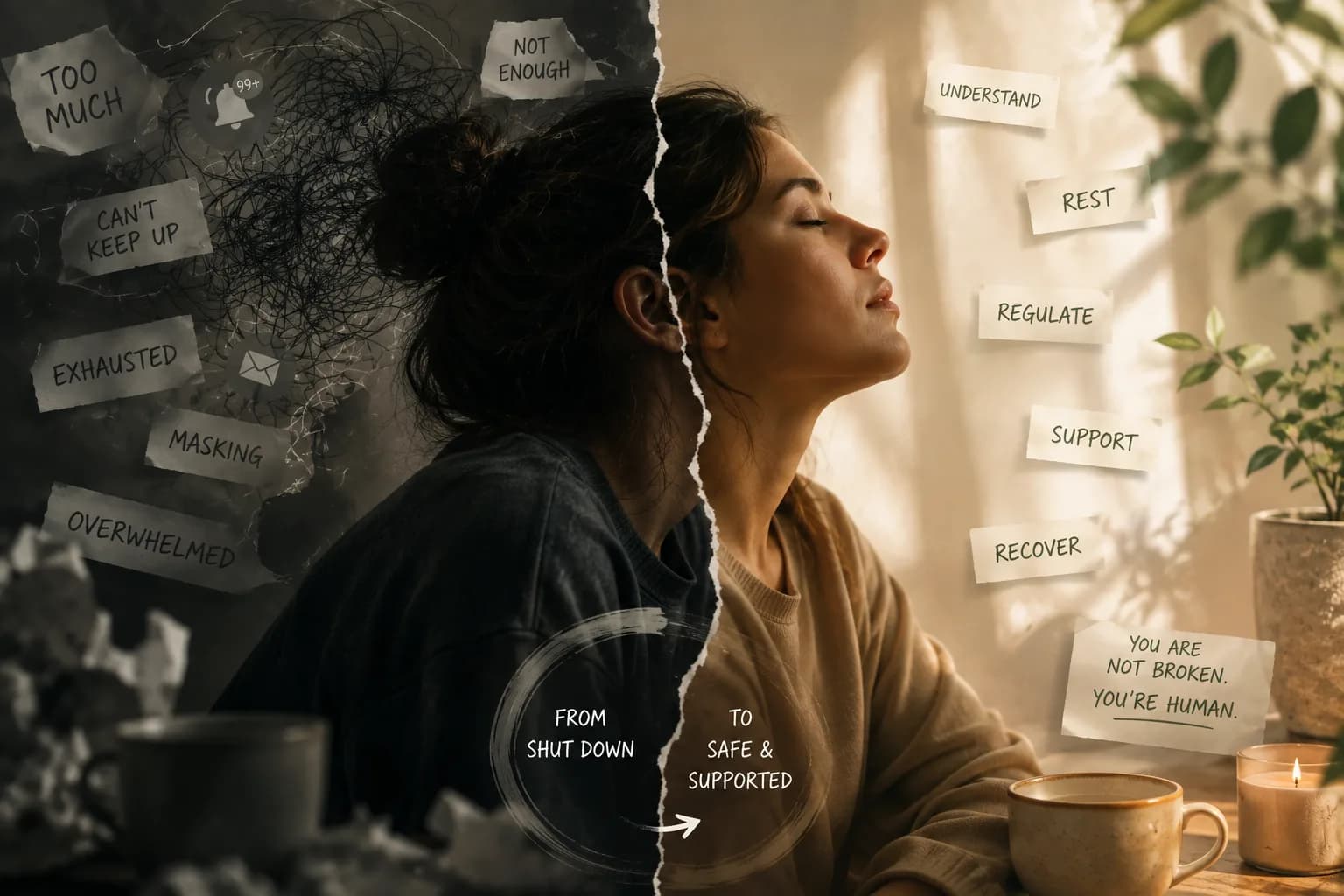
Neurodivergent Burnout Signs and Recovery: When Your Whole System Shuts Down
Neurodivergent burnout signs and recovery are showing up in conversations everywhere right now, from therapy offices to TikTok comment sections, and for good reason. This is not the everyday tiredness that a long weekend can fix. For autistic people, ADHDers, and others whose brains are wired differently, burnout can feel like every system in your body and mind has simply gone offline at once.
If you have been pushing through, masking constantly, and overextending yourself for months or even years, what you are experiencing may be far more serious than ordinary stress. Understanding what is actually happening, and what real recovery looks like, can change everything.
What Makes Neurodivergent Burnout Different
General burnout is real and painful. However, neurodivergent burnout operates on a different scale entirely. The neurotypical framework for burnout typically points to overwork and stress as the main culprits. For neurodivergent people, the causes run deeper and are often invisible to everyone around them.
Chronic masking is one of the biggest drivers. Masking means constantly suppressing your natural neurological responses, forcing eye contact that feels unbearable, performing social scripts that drain your energy, and hiding sensory distress so others feel comfortable. For many autistic and ADHD adults, masking has been happening since childhood, often without any conscious choice in the matter.
Over time, this sustained effort takes a massive neurological toll. The brain and body run on borrowed energy for so long that eventually there is simply nothing left to draw on. That is the moment neurodivergent burnout arrives, not as a gradual fade but often as a sudden, total collapse.
Research by Dr. Monique Botha and colleagues has found that autistic burnout is a distinct clinical experience, characterized by profound exhaustion, loss of previously held skills, and a dramatic reduction in the ability to tolerate sensory and social input. This is not a metaphor. It is a measurable, physiological process.
Physical Signs: Your Body Keeps the Score
When your nervous system has been operating in emergency mode for extended periods, physical symptoms often appear first. These signs of neurodivergent burnout are frequently dismissed as something else, which delays both diagnosis and recovery.
Watch for these physical warning signals:
- Bone-deep fatigue that sleep does not relieve
- Increased sensory sensitivity, where lights feel blinding, sounds feel painful, and clothing textures become intolerable
- Frequent illness, as immune function drops under chronic stress
- Digestive disruption, nausea, or changes in appetite
- Muscle tension, headaches, or unexplained physical pain
- Difficulty with basic self-care tasks like showering or cooking
- Sleep disruption, either sleeping far too much or barely at all
Many people arriving at therapy describe this phase as feeling like they have the flu, except it does not go away. The body has shifted into a survival-only mode. It is conserving every available resource, which means non-essential functions start to drop off.
This is why neurodivergent burnout recovery must include the physical body. Talking alone rarely resolves a nervous system that is stuck in this state.
Emotional Signs: Numbness, Grief, and Overwhelm
The emotional landscape of neurodivergent burnout is layered and often confusing. You might expect to feel stressed or anxious. However, many people report something closer to emotional flatness, a gray numbness where feelings used to be.
This shutdown response is a self-protective mechanism. When emotional processing becomes too overwhelming, the system turns the volume down. The result can look like depression from the outside, and it is frequently misdiagnosed as such.
Other emotional signs include:
- Sudden, intense grief about your own life, often arriving without warning
- Rage or irritability that feels out of proportion and difficult to control
- A profound loss of interest in things that used to bring you joy
- Feeling disconnected from yourself or your sense of identity
- Shame spirals triggered by even minor mistakes or perceived failures
- Difficulty identifying what you actually feel or need
For late-identified neurodivergent adults especially, burnout often carries a deep layer of grief. You may find yourself mourning the years spent masking, the relationships damaged by misunderstanding, and the version of yourself you never got to be. That grief is legitimate, and it needs space in any honest recovery process.
If you want to understand more about how late identification intersects with these experiences, the piece on autism therapy for late diagnosis adults offers a personal and grounded look at this terrain.
Cognitive Signs: When Your Brain Goes Offline
Cognitive symptoms are some of the most frightening aspects of neurodivergent burnout, partly because they can signal a loss of skills that you relied on and built an identity around.
The brain, like any system that has been running on empty, starts to shed non-critical functions. For neurodivergent people, this can mean a regression in abilities that took enormous effort to develop in the first place.
Cognitive signs to watch for:
- Executive dysfunction worsening dramatically, tasks that used to feel manageable now feel impossible
- Language processing difficulties, including losing words, struggling to form sentences, or going nonverbal
- Memory problems, both short-term recall and the ability to hold plans in mind
- Difficulty with reading, writing, or following conversations that used to feel natural
- Decision fatigue arriving almost immediately, even for small choices
- Autistic regression, a return to earlier coping behaviors or communication styles
This skill loss is one of the most disorienting parts of the full burnout experience. People often describe feeling like they have lost themselves. In a sense, the highly adapted, carefully constructed version of themselves has stopped functioning. What remains feels raw and unfamiliar.
It is worth noting that this experience overlaps significantly with how ADHD burnout presents, though the mechanisms differ somewhat. If you suspect your experience has an ADHD dimension, the post When Burnout Looked Like Laziness: ADHD Burnout Therapy for Adults covers that intersection thoughtfully.
Why Neurodivergent Burnout Is So Frequently Missed
One reason recovery is delayed for so many people is that neurodivergent burnout does not look like what our culture expects burnout to look like. The hustle-culture version of burnout happens to successful, visibly productive people who finally crash. Neurodivergent burnout can happen to someone who, from the outside, appears to be doing very little.
Because neurodivergent people often spend enormous energy just getting through ordinary days, the effort that leads to burnout is invisible. A neurotypical observer sees someone who went to work, came home, and watched television. They do not see the constant sensory filtering, the real-time social translation, the executive function battles, and the emotional regulation labor that filled every moment of that seemingly ordinary day.
This invisibility means neurodivergent burnout is frequently labeled as laziness, depression, a personality problem, or a failure of motivation. All of those labels add shame to an already depleted system. Shame, in turn, slows recovery significantly.
If your burnout has been misread as a mood disorder or character flaw, you are far from alone. The connection between neurodivergence, trauma, and these misattributions is explored in detail in the article on trauma and neurodivergence therapy, which traces one person's path through exactly this kind of misunderstanding.
What Neurodivergent Burnout Recovery Actually Looks Like
Here is something important: you cannot recover from neurodivergent burnout by pushing harder or by applying neurotypical productivity strategies. Rest-as-recovery is real, but it is only the first layer. Genuine recovery requires structural change, not just a vacation.
Recovery unfolds in phases, roughly like this:
Phase 1: Reduce the load. Before anything else can happen, the demands on your nervous system need to decrease. This means reducing sensory input, social obligations, and performance requirements wherever possible. This phase can feel like failure. It is not.
Phase 2: Rebuild safety in your body. A nervous system stuck in threat mode cannot heal through cognitive work alone. Somatic approaches, breathwork, gentle movement, and sensory regulation practices all help signal safety to the body. This is where trauma-informed care becomes essential.
Phase 3: Examine the masking. Recovery is not about returning to the pre-burnout baseline, because that baseline was often the cause of the burnout. Sustainable recovery requires looking honestly at which masks can come off and which environments are genuinely incompatible with your neurological needs.
Phase 4: Rebuild with realistic scaffolding. Slowly reintroducing activity, with genuine accommodations and much lower expectations for masking, creates a new baseline. This phase requires patience. Progress is often two steps forward and one step back.
Phase 5: Long-term maintenance. Burnout recovery is not a finish line. It is an ongoing practice of monitoring your nervous system, honoring your limits, and advocating for what you need. A good therapist helps you build this capacity rather than just managing symptoms.
How Therapy Supports Neurodivergent Burnout Recovery
Therapy for neurodivergent burnout looks different from traditional talk therapy. A neuro-affirming therapist does not treat your neurological differences as problems to solve. Instead, the goal is to understand your system, reduce unnecessary stress, and support you in building a life that fits how you actually work.
Effective therapeutic approaches for this kind of burnout recovery often include:
- Somatic and nervous system regulation work
- Grief processing around late identification or lost years
- Practical support for executive dysfunction and self-care
- Exploration of masking patterns and their origins
- Advocacy skills for workplace and relational contexts
- Identity work, especially for those who are newly identified
The relationship between therapist and client matters enormously. Neurodivergent burnout is often rooted partly in a lifetime of feeling misread and unseen. A therapeutic relationship that gets you, accurately and without judgment, is itself part of the healing.
You Deserve Recovery, Not Just Survival
Neurodivergent burnout signs and recovery deserve to be understood as a whole-system experience, not just a bad stretch of weeks. If your body is exhausted, your emotions are either overwhelming or absent, and your cognition has started dropping offline, you are not broken. You are a nervous system that has been running an impossible load for far too long.
The path forward is real. It requires slowing down, getting accurate support, and making changes that go deeper than willpower. Recovery from neurodivergent burnout is not about becoming a more efficient mask-wearer. It is about building a life where masking less becomes possible.
That is the kind of recovery worth working toward.